
My Professional Background


I am a Certified Professional Inspector trained by InterNACHI® — the International Association of Certified Home Inspectors — and a U.S. Navy veteran with over 30 years of experience in the public and private sectors. I hold an undergraduate degree in Wildlife and Fisheries Science with a minor in Forestry from the University of Tennessee, Knoxville, and a graduate degree in Business Management and Leadership from Webster University in St. Louis, Missouri.


While serving in the Navy, I deployed on two 6-month deployments to the Persian Gulf during Operation Southern Watch. My military experience involved maintaining accurate equipment repair records and working as an electrician on F-14 fighter jets. These duties taught me attention to detail that enables me to spot defects during home inspections in home systems, materials, installation, and workmanship that other inspectors might miss.


Over my career in public service spanning 22+ years, the vast majority of my experience involved inspections and writing professionally as a Transportation Ecologist, Airport Biologist, and Rural Forester. Using a scientific approach to analyzing information helps me to accurately collect, interpret, and report findings during home inspections. My background in ecology also uniquely qualifies me to examine environmental features, surface drainage patterns and groundwater influence, vegetative growth near structures, moisture intrusion issues, etc., associated with your property.
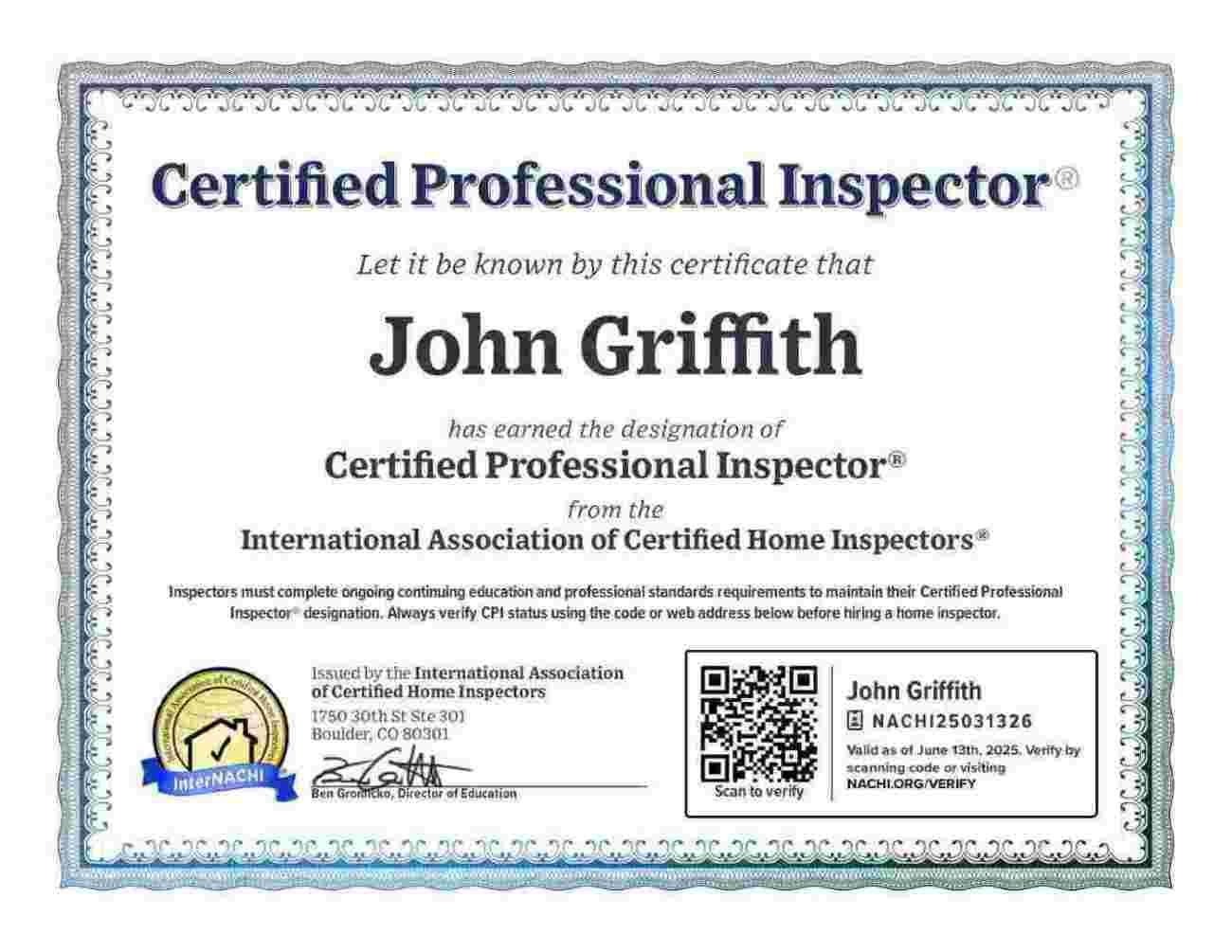
Certification for Professional Inspector

My Qualifications

checklist

Work Experience


Over the course of my career, I have conducted thousands of reviews of infrastructure projects across Tennessee, worked with Georgia landowners developing forestry practices, addressed human-wildlife interactions at a Marine Corps Air Station, and have personally conducted hundreds of environmental inspections across Tennessee, Southwest Georgia, and coastal North Carolina.


I have written professionally my entire career and have significant experience serving as a liaison between federal, state, and private entities. I can help you navigate the complexities of a real estate transaction with a comprehensive home inspection and a report that you can rely on!

graduate

College Certifications


I received my professional home inspection training and certification through InterNACHI® School. The InterNACHI® School is the only home inspector school accredited by a national accrediting agency of the U.S. Department of Education (USDE) and is also a Member College of the National Association of Career Colleges (NACC) of Canada.


I also hold a Bachelor's Degree in Science and a Master's Degree in Business. 

Standard of Excellence


I follow Tennessee's Standards of Practice (link below) which ensures that you receive a detailed and accurate home inspection. I also abide by a strict Code of Ethics, which puts your interests first and protects your rights as a customer.


In addition to the Continuing Education (CE) requirements by the State of Tennessee to maintain a home inspector's license, InterNACHI also requires the following of their professional inspectors:


  1. Complete 24 hours of CE every year.
  2. Abide by the InterNACHI® Code of Ethics.
  3. Maintain an Official Education Record.
  4. Pass the InterNACHI® Online Inspector Examination every three years.
  5. Substantially adhere to the InterNACHI® Standards of Practice that apply to the inspection service or adhere to the local standards required by law.
  6. Maintain an All-Access Membership at InterNACHI®
TN Standards of Practice

Why Choose Me?

>20

Years of Relevant Experience

>4,000

Project Reviews and Written Responses

>200

Professional Inspections Performed

FAQ

  • How much does a home inspection cost in Tennessee?

    Determining the cost for a home inspection in Tennessee usually involves a calculation of square footage, age of the home, and driving distance for the inspection. The average cost is probably somewhere around $400-$500 for smaller to mid-sized homes and $700 or more for larger homes. This does not include additional costs for ancillary inspections such as thermal imaging, termite, etc. Also, it is common for inspectors to calculate total square footage of a home in their price estimatations. This includes not only finished space, but unfinished space as well.


    At Higher Rock Inspections, we use a clear method for pricing our inspections that considers only finished space, the age of the home, and driving distance. We define finished space as fully completed and suitable for year-round occupancy (e.g., contains features like finished floors, walls, ceilings, and heating or cooling systems).  Unfinished areas (e.g., open basements and attached, unfinished rooms) are included in our inspection free of charge! 


    Most will agree that we owe a debt of gratitude to those who sacrifice and serve. As a way of showing my appreciation, I offer 10% discounts, with proof of eligibility, for public servants, military (including veterans), and first responders.

  • How long does a home inspection take to complete?

    My typical home inspection lasts between 3-4 hours. I want to ensure that I provide you with the most comprehensive inspection possible. 


    The report will not be completed onsite, aside from documenting observations and taking plenty of pictures, so that I can focus my attention on inspecting the systems and components of your home. I am always available during and after the inspection to answer any questions you may have! 


    Your report is typically delivered within 24 hrs of finishing the inspection or the next working day if the inspection occurs on Friday.  My report is designed to clearly explain my observations and provide appropriate recommendations for repair, further assessment, or monitoring. In addition, I am always available to explain my findings, so please reach out to me with any questions!

  • What is involved in a typical home inspection?

    When I inspect, I will be looking at the building site, including driveway, slope, drainage and environmental features; exterior; deck, porch, and balcony areas; roof; interior walls, ceilings, and floors; windows and doors; visible foundation and structural components; basement or crawlspace; plumbing; electrical system; HVAC system and ductwork; attic, insulation, and ventilation; and attached garage or carport. 


    I encourage you to attend your inspection so that I can describe my process, explain my findings, point out important maintenance issues, and answer all of your questions!

  • What are the most important questions to ask?

    One of the most important things to understand is the limitations of a home inspection. While I often use technology and tools to better identify issues, a home inspection is by definition a visual, non-invasive inspection of the home. Even on inspections where I utilize thermal imaging, views are limited to the surface of objects and I'm unable to see through walls or behind furniture, beneath rugs, or inside inaccessible spaces (e.g., locked rooms). 


    To the extent possible, furniture should be moved away from walls, doors unlocked, and personal items removed before the scheduled home inspection. Any inaccessible systems, components, or areas will be noted in the report with a proper explanation as to why they could not be inspected. 


    Another important consideration is the differences in the classifications of defects that you could see in your report. For example, safety issues and major defects are ones that you will want to address as quickly as possible and they may require a professional contractor, electrician, HVAC technician, etc., to make the repairs. These tend to be costlier than repairs on minor defects that can often be made by the homeowner. Cosmetic defects are just that- aesthetic issues such as a stain in the carpet or a scratch on the kitchen cabinet that do not affect the functionality of the component or system.